A funny wedding: The tale of two stand-ins

•August 17, 2009 • 1 Comment


Abbie, you finally got your wish. Here’s the first blog on our ‘beautiful family’!

Exactly six years ago, our eldest daughter, Tricia, got married to Joey at the San Agustin church in Malate, Manila. The couple met each other as officemates in Bayantel but Joey soon moved on to Globe Telecom after they got married. A month or so before the wedding, my eldest brother, Manong Eddie, stood in for me for the traditional pamamanhikan, where Joey with his family in tow, formally asked for Tricia’s hand in marriage. He had to do it for me. I was down with the flu at the time. To this date, I maintain that that flu did not mean I was objecting in any way to the marriage of my first born child. Could simply have been the proverbial butterflies in my tummy. In truth, I was quite happy that Tricia will get married.

After the successful pamamanhikan, both families got involved in the web of preparations for the wedding—the wedding entourage, trousseau, reception, invitations, etc. On the day before the wedding, we billeted ourselves in a nearby hotel so we could, take note, and get to the church on time. On the day itself, everybody dressed up but the trip to the church was delayed by the seemingly endless picture-taking. As the hour approached, common sense prevailed and we started to travel to the church. Rosalie and son Aarlo joined Tricia in the bridal car while I drove the family car. With me were our daughters Ma. Lorena and Sabrina, and a niece, Katherine. Olayne, Sab, and Kat-Kat were all members of the bridal entourage.

While we driving to San Agustin, the Tourism Department then headed by now-Senator Dick Gordon was holding a huge parade-cum-extravaganza in the area. Needless to say, we got caught in the jam and I tried to find a way through the narrow streets. We then decided to park the car somewhere and make a RUN for it. I was wearing the traditional round-necked T-shirt that serves as an undershirt to the formal barong
I was carrying in a hanger. All of my companions were in long gowns and high-heeled shoes. And we were all running like crazy towards the church with me leading the way. Every once in a while, I would look back and see the girls who were struggling as their heels occasionally getting stuck between the cracks of cobble-stoned streets of Intramuros.

To cut a long story short, the father of the bride and three members of her entourage were missing. The wedding coordinator was quite frantic since San Agustin was quite strict about wedding schedules. She made a nifty adjustment though. Instead of simply waiting for me to show up, she asked my brother-in-law, Manong Ed (who was otherwise not tasked with any formal role in the wedding and who happened to be in a barong), to stand in for me for the bridal entourage’s entry—the part where the bride and her father march along the aisle up to the groom and the father symbolically hands over his daughter to his future son-in-law.

The wedding entourage started moving. It was this point that the four panting and sweating stragglers arrived in San Agustin. Since she was on the look-out, the wedding coordinator immediately saw me and signaled me to get in place. I was running with both hands up so she can help me slip into the barong. I think she was assisted by one of her staff. She took care of one sleeve while the second one was taken care of by the other. Of course, a good number of family and friends gathered in the church did not know what was going on and were simultaneously perplexed and amused.

Manong Ed’s wife was preparing to take a picture of Tricia and Manong Ed. She looked away for a sec, then focused her camera once more—and Manong Ed morphed into moi, Bong(!), whose perspiration was being wiped away by the same dutiful wedding coordinator.

Happily, no additional mishap marred the beautifully solemn wedding ceremony. But then everybody was amused and laughing over what happened. At the reception’s start, Tricia laughingly complained that I stole the limelight from her and her handsome groom and that perhaps I did it intentionally. But she ain’t seen nothing yet. When I was asked to give a few words of advice to the newly-weds, I did so but also sang “Smile” a cappela. With all modesty, that brought the house down especially when I wiped the tears off Rosalie’s face with my handkerchief.

Happy anniversary Tricia and Joey! Hindi ko talaga sinadyang agawan kayo ng eksena (I didn’t intend to steal the limelight from you both). If there is anybody to blame, that’s Dick Gordon!


What a week!

•August 13, 2009 • Leave a Comment

I know, I know, I know. This blog should have been written and posted four days ago. And I should be blogging on more recent events. But I need to get this particular blog done and ‘out of the way’.

The obvious high point of the fantastic week was Tita Cory’s death, wake, and funeral. I believe I wrote the blog on property rights before my wife Rosalie and I tried to line up at the La Salle Greenhills gymnasium to view her remains. We failed to do so. Monday was the transfer of her remains to the Manila Cathedral. I wanted to join the march but also wanted to attend the second lecture of John Nye at the UP School of Economics. Since I cannot be in two places at the same time, I had to be content with monitoring the march through radio, TV and text messages.

I had classes Tuesday so I couldn’t go the Cathedral. Rosalie couldn’t wait for me so she went with my niece and her friend. They were able to see Tita Cory’s remains at about 4:30am Wednesday morning after lining up for about five hours. While in the queue, those who were filing out of the church warned them that the viewing might be stopped at 4:00 am but could not give any reason why this would be so. They still decided to stay on the line. Soon after, they will learn that the public viewing was temporarily stopped to accommodate GMA.

Wednesday was the internment of her remains so I had to make my move. I drove over to Laloma, left my car at my-in-laws’ place (where Rosalie was monitoring the proceedings at the Cathedral on ABS-CBN), and proceeded to install myself among so many in front of the Manila Hotel at about 10:00 am. I got to see Tita Cory’s remains around 1:00 pm together with the by-now famous honor guard. Noynoy spoke for a few minutes while Mayor Lim and his men tried to instill some order amidst the predominantly celebratory (as in fiesta) atmosphere. The crowd started following the flat-bed truck carrying her remains and I decided to join them. I didn’t know at the time how far I can walk since the last time I joined a march was in 1987—another funeral march for the student leader Lean Alejandro—22 years ago.

The crowd’s energy, together with the wailing of countless fire trucks’ sirens and a huge ocean-going ship’s horn, invigorated me and everybody else to march on. However, the spirit may be willing but the body was not quite up to it. I joined the march from Manila Hotel through Quirino Avenue up to Taft Avenue. My umbrella was broken by the strong winds and my shirt was wet from sweat, rain, and sea spray. I had a meal at about 3 pm at a nearby fast-food joint and proceeded by jeepney back to Laloma where we watched the solemn burial of Tita Cory amidst full military honors.

If the week started and was highlighted by a death and burial of Tita Cory, it ended with another death, this time of a less famous person but still a beloved one. In the afternoon of August, I started receiving a stream of text messages announcing the death of my fraternity brod and comrade Arnel (aka Batman) de Guzman. Arnel is a fascinating character and a compleat human being, obviously not without faults but a beautiful person just the same. He was activist, professor, consultant, writer, and fraternal brother all rolled into one. His activism was broad ranged: from human rights to migrant worker concerns.  Remembering his impishly mischievous grin, we who he left behind chose to celebrate his full life instead of just grieving.  Just like what we did with Tita Cory’s demise.

In between these deaths are the two world class lectures of John Nye of the George Mason University and currently visiting professor at the UP School of Economics. John was supposed to deliver three lectures; the first one was done on July 20 and the second was supposed to have been delivered on July 27. However, John got sick allegedly due to dust in the UP Main Library and the July 27 lecture was delivered on August 3—the day Tita Cory’s remains were transferred to the Manila Cathedral. The third lecture was done on August 7, a day before Arnel’s death.

John’s lectures were on ‘the new institutional economics’ (NIE). I had been reading on the literature ever since I got hooked on the work of Douglass North (on economic performance and time) while on a fellowship in Finland in 1997. However, I cannot claim expertise on the subject. John’s lecture (especially the first and second) gave an extremely useful overview of NIE, which included his own work. John worked with North at the Washington University at St. Louis, Missouri for some 20 years before he transferred to George Mason.

His third lecture was actually a presentation of two new papers. One resurrects the debate between the monetarists and the Keynesians regarding the relative efficacy of monetary easing over fiscal spending to stimulate growth and get economies out of crisis. While arguing for the monetarist case, John criticized the Obama administration’s avowedly Keynesian economic stimulus program for not being Keynesian enough.

His other paper is an exercise in what he calls ‘freak-economics’: an examination of the so-called dragon effect. In the Chinese lunar calendar, the dragon is considered the luckiest animal. Surveying demographic data, John noticed a demographic spike in several countries that adhere to the lunar calendar (Taiwan, Vietnam, South Korea, and Singapore) during the dragon years of 1976, 1988 and 2000. For these countries, birth rates were going down but upticks were observed during the dragon years. Which means that couples, or at the most, mothers, were purposely ‘timing’ pregnancies so their babies will be dragon babies? In John’s book, that means a lot of sacrifice.

Now he wants to know if the sacrifice was worth it. Wouldn’t it be counter-productive to have your baby born in a dragon year? More babies will be born in the same year and they will all be competing for resources, the most important of which would be the best schools. Without boring you with methodological details, John compared Asian and non-Asian immigrants in the United States (those who believed in the dragon effect and those who didn’t). With respect to the 1976 cohort, he found that dragon children had on average had a year’s edge in college education over non-dragon children on top of the fact that Asians were better educated than non-Asians (mostly Latinos).

John fielded questions about the mother effect since he also found that mothers of dragon children were generally older, better educated and richer than non-Asian mothers of children born in the same dragon year. In a typical economist fashion, he said that the best way to eliminate the mother effect is to study at least two siblings—a dragon and a non-dragon and compare their relative performance say in school. John said a study in Vietnam did just that and came up with similar findings. In the end, John jokingly said he will be gainfully employed in the years to come even if he concentrates only on studying the dragon effect.

All in all, the week that was is one of the most memorable and productive weeks I have gone through so far. And I have only begun to scratch the surface. I will soon blog on the visit of the Marcos children at Tita Cory’s wake and relate it to property rights squabbles of Philippine elites. In that blog, I will use the insights of neorealist international relations (IR) theory to help shed light on the possible resolution of such contests.

Property rights issues in the Philippines

•August 2, 2009 • Leave a Comment

Last Friday, I attended a symposium entitled ‘Will Elites Allow Reform: Property Rights Issues in the Philippines’ at the UP School of Economics. One of the speakers, Prof. John Nye of the George Mason University, argued that a necessary condition for economic growth is ending the vicious cycle of vindictiveness amongst the elite fractions in the country. He said that if those in power are (deadly) sure of being punished by incoming elites, the latter will cling to power by all means. In the end, these elite struggles will harm the prospects of economic growth.

UP SE dean Noel de Dios invited me to join John and others to dinner after the symposium. On our way to Trinoma, we mulled on the possibility of ending vindictiveness amongst elites and concluded that it was a problem of ‘credible commitment’. Absent a third party enforcer, how will the ‘ins’ be assured that the ‘outs’ will not punish them when the former were the new ‘outs’? Which led us to property rights issues.

The property rights system of the country is a product both of its colonial history and developments over the past few decades. The Spanish colonial state sought to impose property rights regimes that were alien to those previously instituted by the indigenous peoples of the archipelago, which included stewardship, usufruct, and communal ownership. In the process, massive asset theft typical of all colonial ventures occurred in the country. The main object of theft and ownership then was arable land. While resolving the ownership of the so-called ‘friar estates’, the American colonial state also introduced the distinction between public and inalienable land and privately-owned and alienable real estate. This had the further effect of legally disenfranchising indigenous peoples from their land. The 1946-1972 post-colonial state continued these Western-originated property regimes even as the asset structure diversified over time. In general, access to political power guaranteed security of property rights and elites at various levels consolidated their political and economic positions.

Up to the eve of the declaration of martial law in September 1972, the property rights of rival elite factions were generally secure regardless of the political cycle’s outcome. Ownership rights were not extinguished by an electoral loss. The elites were organized into two political parties that alternated in power at the national level. These parties were roughly at par with each other in terms of power and resources. The ability of an elite faction to regain power in the next election deterred the faction in power from erasing the property rights of the ‘outs.’ Elite factions, therefore, were prevented by the possibility of electoral defeat from disrespecting the property rights of their rivals. The default behaviour was for the ‘ins’ to plunder the state treasury and cash in on the ‘economic rents’ created during incumbency instead of confiscating the property of the ‘outs.’ Notwithstanding a constitutional provision for two presidential terms, no president has been able to win re-election until 1969 when Ferdinand Marcos won an unprecedented second term.

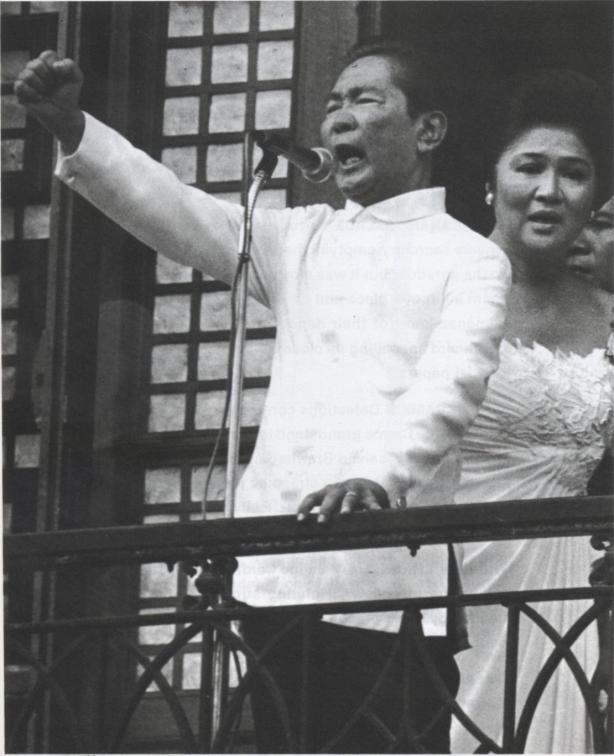
The balance of power between the rival elite factions shifted decisively in favour of his faction after Marcos’ unprecedented re-election in 1969. He monopolized political power through the declaration of martial law in September 1972 and proceeded to violate the property rights of his political opponents. The demise of the dictatorship in February 1986 saw the post-Marcos elites attempting a restoration of pre-martial law arrangements with respect to property rights and access to political power. The properties of the anti-Marcos elites (such as the Lopez, Lopa, and Jacinto families) were returned to their former owners while a new constitution adopted in 1987 provided the ground rules for political contestation and all but forestalled the possibility of new dictatorships. After an initial lock-out period, even the Marcoses were allowed back into the country and managed to win electoral posts or stand for elections. Despite the formation of a presidential commission mandated to recover the so-called ill-gotten wealth of the Marcoses and their cronies, these properties got entangled in a quagmire of unresolved law suits filed within and without the country.

The violation of elite property rights by Marcos during the dictatorship’s heyday is like a genie let out of the bottle. Despite all efforts to date, the mess created by the initial massive cancellation of property rights has not been sorted out to satisfaction. The ownership of substantial portions of major Philippine corporations (including the top-ranked San Miguel Corporation and the Philippine Long Distance Telephone Company) remains contested. The fall of the dictatorship also led to the recognition of new asset claimants—the thousands of human rights victims who were tortured or murdered by Marcos’ security forces and the coconut farmers disenfranchised by the so-called coconut levy. The claims of the human rights victims against the Marcos estate had been repeatedly recognized by US courts while the Philippine Supreme Court had frequently ruled that the coconut levy was a public fund and must be taken from the control of businessman Eduardo Cojuangco, who used the money to wrest control of the country’s premier business firm—the San Miguel Corporation (SMC). To date, however, none of these judicial decisions have been enforced since rival claimants have managed to secure restraining orders against them.

The discussion so far indicates that from 1946 to 1972, there was an institutional mechanism that ‘tamed’ the relations between rival elite fractions in the Philippines. We have shown how such a mechanism was shattered by Marcos. We pointed to the difficulty of repairing the ‘property rights mess’ of the martial law period even after the dictatorship’s demise. In my next blog, I will discuss why the cycle of vindictiveness amongst Filipino elites seems to be more intractable during the post-Marcos period. However, I also promise to answer the questions raised by Raul Pangalangan and Rex Ubac re my blog on GMA’s supposedly last SONA. Patience!

Why should she?

•July 27, 2009 • 2 Comments

As in her previous State of Nation Addresses (SONAs), President GMA reported on her administration’s many accomplishments and claimed that the ’state of the nation is a strong economy’.

She disappointed those who expected her, including her many critics, to make a categorical statement that it was to be her last SONA, that presidential elections will be held in May 2010, and that she will definitely step down from power on June 30, 2010. The closest statement she made to that effect was a declaration that she never aspired for extending her term beyond 2010.

But those who expected such categorical statements are bound to be disappointed. Why should GMA make such a statement? For one, GMA has not honored a Rizal Day 2002 declaration that she will not seek the presidential office in the May 2004 polls. When she did run, it was the first time that an incumbent run for office (under the terms of the 1987 Constitution) and predictably took advantage of vast government resources for her candidacy. Since the Garci tape revelations in mid-2005, her trust ratings had been consistently down. So if she said that she will step down in June 2010, will we believe her? Knowing we won’t believe her, why should she oblige us?

In her SONA, GMA scored some brownie points against Erap and FVR, both of which were pushing for Charter Change (Cha-Cha) during their terms but who are now opposing the same efforts pushed by the current administration. She also reminded the nation of the profligate lifestyle of Erap, claiming that somebody who had been jailed (and who should have been still in jail) should be the last one to carp about corruption and governance.

GMA conveniently forgets that she pardoned Erap. Therefore, she should not ‘complain’ that he is out free and running about as an aspiring presidential candidate (constitutional issues notwithstanding). Furthermore, every citizen (including ex-presidents deposed by ‘people power’) retains the right to criticize any sitting government of the Republic. GMA does not enjoy the privilege of lese majeste of the Thai monarch. Or perhaps, she wishes she does.

GMA failed to follow Tita Cory’s example in the latter’s July 1991 SONA when she thanked everybody and said farewell to the nation. GMA also forgets to mention that Tita Cory herself is against Cha-Cha and all other schemes to circumvent terms limits for the presidency.

No constitution is sacred and is thus amenable to change. However, any Cha-Cha initiative of an incumbent president (especially one with consistently low or negative net trust ratings) will be perceived (rightly or wrongly) as an attempt to stay in power after her term’s expiration. It is best that a Cha-Cha initiative be launched during the early part of an incumbent’s term, preferably within her first year. It is likewise pro forma that the incumbent should not benefit from the new provisions of the charter.

Interviewed by Ted Failon, my retired colleague Prof. Felipe Miranda believed that GMA did not make a categorical statement regarding her political future since she was probably thinking there may still be ways to stay in office after June 2010. I agree with him and note that we have a whole year between now and June 2010. Other commentators have noted that her confidence is so absolute that she may be faulted for a lack of self-reflection.

What we have here is an extremely confident politician who believes it is to her best interest to keep everybody (foes and friends alike) guessing about her intentions. Whether she will emerge as a ‘winner’ in the end remains to be seen. A greater concern however is whether the nation also ‘wins’ with her.


Mobile capital and governance

•July 20, 2009 • 1 Comment

The notion that mobile capital is a powerful corrective to malgovernance has a noble lineage from Adam Smith, David Hume, and Montesquieu. In recent years, the idea was resurrected by globalists and like-minded entities such as ratings agencies and multi-lateral financial institutions.

To Smith’s mind, malgovernance is equivalent to excessive taxation of capital and property, not taxation per se, as he recognized the need for public goods and the role of the state in the provision of such goods. Malgovernance is a disincentive to investment and owners of transportable assets can readily change domiciles to jurisdictions with acceptable tax burdens. Smith argued that a tax burden is acceptable to businessmen to the extent that the state is able to provide an equally acceptable bundle of public goods.

To businessmen, therefore, tax payments are akin to capital outlays for durable goods. The key public goods include internal order and political stability, a reliable system of property rights, contract enforcement, and dispute settlement, and public infrastructure. Neoclassical microeconomics asserts that rational businessmen will pay taxes to the extent that the monetary value of the marginal public good, or MPG (reckoned as a valuable collective product), is equal to the marginal tax cost MTC). Given the distinct possibility of free riding, taxes are paid starting from the point where MPG > MTC and stops when MPG = MTC.

The phenomenon of free-riding requires that tax collection can be done best through an entity imbued with legitimacy and a monopoly of legitimized means of violence–that is, the state. This means that the payment of taxes is never voluntary and it takes a coercive agency to collect taxes. This is not to say that non-state actors cannot collect taxes or provide the substantial equivalent of public goods. States and non-states must have access to means of violence so they can collect taxes. However, only states can collect taxes legitimately. When non-state actors, such as insurgent armies do so, this activity is rightfully called extortion (albeit revolutionary).

By default, states are accorded legitimacy. However, like all political goods, legitimacy is exhaustible. A state’s legitimacy is directly related to the magnitude and the sign of the difference between MPG and MTC, a quantity we designate as net public good (NPG). If MPG > MTC or if equivalently, (MPG -MTC) > 0, legitimacy has a positive value. The greater the value of NPG, the greater the amount of legitimacy a state enjoys. As NPG decreases, state legitimacy similarly goes down. Should NPG take on a negative value (or should MPG < MTC), then the collecting state is considered illegitimate and engaged in plunder.

If L was the state’s legitimacy, then L is a function of net public goods (NPG) or the difference between marginal public good (MPG) and marginal tax cost (MTC). The L function could be written as L = f(NPG) = f(MPG-MTC) or L = k NPG = k (MPG-MTC), where k is some constant between 1 and zero.

The aforementioned points are crucial since the time gap between tax payment and realization of the same in terms of public goods is quite substantial. Notwithstanding the innate legitimacy of the state, rulers and bureaucrats may choose to use public tax revenues to provide private instead of public goods. When they do so, the state begins to lose legitimacy and anti-state actors (that could provide the equivalent of public goods) would gain viability and could eventually replace the illegitimate state in power. When economic agents pay their taxes, they do not have any guarantee that they will get anything in return save for a receipt. They cannot use the same receipt to demand a refund should the public goods they expect fail to materialize. This lack of certainty of getting something in return is another reason why economic agents do not readily pay taxes.

How potent is capital mobility against malgovernance? It is obvious that its potency is limited given that malgovernance is the norm rather than the exception in the contemporary world. Why is this the case? For one, capital mobility is not perfect. The state is not entirely helpless and has various devices at its disposal to reduce capital’s mobility. Even potential receiving states may have barriers to the free entry of migratory capital. Secondly, not all capital is fluid; some capital may be tied down in fixed and other assets and capital owners must sustain prohibitive transactions costs before these assets could be transformed into transportable ones. Lastly and most importantly, there may be substantial interests (domestic and foreign) who are rather impervious to capital’s mobility. Some of them welcome the outflow of capital if it results in a less-competitive situation where they will have greater control over market prices. Others may not need to interact with mobile foreign capital and will therefore remain unaffected by their exit. Still some others may be quite satisfied with a feckless state that allows their illicit businesses to operate and prosper. In truth, there exists a substantial politico-economic constituency that profits from state weakness and is quite impervious to the disciplinary strictures of mobile capital.

There is a fourth reason for mobile capitals’ relative impotence. Differences in time horizons require decomposition of mobile capital. Direct investors may have greater concern about the quality of governance since they have longer time horizons compared to owners and managers of portfolio capital or so-called ‘hot money’. Of greater concern to the latter is the capital account regime, that is, if the host state has a liberal regime that allows for the unimpeded movement of foreign exchange. Provided superior margins could be made in the short run and provided earnings could easily be repatriated, portfolio capital may still be attracted to jurisdictions with poor governance. To some extent, the institutional weakness of the host state can offer windfall profit opportunities for extremely mobile capital. Occasional crises may lower asset prices and offer portfolio capitalists more attractive buys. In addition, bureaucracies in weak states will offer all sorts of incentives to offset institutional infirmities and enhance returns on investments. To be sure, better governance may bring higher returns to portfolio investments. But ‘hot money’ managers may not have the patience or the inclination to wait for better institutions to evolve. They may in fact be penalized by their principals if they don’t respond to better profit opportunities elsewhere.

Notwithstanding the point above, it does not follow that direct investors have a natural predisposition for good governance. When and where rents could be captured, entrepreneurs will not refuse to do so. Thus, direct investors will differ with each other in regard to their political connections and acumen. To the extent that rent-seekers have captured the state or a substantial amount of the economic space, the disciplinary power of mobile capital is consequently reduced.

Tita Cory’s ‘quiet’ charisma

•July 14, 2009 • 5 Comments

Over the past few weeks, Filipinos from all walks of life have been praying or offering masses for former President Corazon C. Aquino (affectionately known as Tita Cory).  Tita Cory is battling colon cancer and has reportedly checked into a hospital for her inability to eat.

She may still be alive but Tita Cory had long passed into the pages of our country’s history.

Though flat and unspectacular, she drew a wide following and led the nation in the end-game against the Marcos dictatorship from August 1983 to February 1986.  She reluctantly assumed that role after the assassination of her husband, former Senator Ninoy Aquino.  Mocked by Imelda as a ‘mere housewife’ who lacked the bombast and the experience of traditional ’strong-men’ Filipino politicians, she challenged the wily dictator in a one-on-one contest in the 1986 snap presidential elections.

Cory admitted that she indeed was a mere housewife (even if no ordinary housewife) and she didn’t know a lot of things.  For instance, she did not know how to engage in the record corruption that was associated with the Marcoses, their relatives and cronies.

That she was able to respond to Marcos’ riposte with sarcasm indicated political sophistication. Sophistication that was not apparent to an adversary consumed by hubris.

At her term’s end, Tita Cory reported to the nation that she has accomplished a self-imposed task—that of presiding over the troubled transition from authoritarian rule to democracy.  One can validly complain over the quality of our democracy.  However, given the choice between flawed democracy and Marcosian rule, my preference is clear.

The Social Weather Stations (SWS) recently reported a 60% trust rating for Tita Cory, the highest figure so far for former presidents.  I believe Cory continues to enjoy popular support not only because of the clear positions she has taken on current political controversies.  I think her moral ascendancy is quite apparent; that she is atypically transparent.

Of course, I did not agree with all that she had done during her presidency.  The influence of Catholic Church on her was excessive.  I squirmed everytime she appeared on TV to call on the nation to pray especially when Malacanang was beset by various coup attempts.  Obviously, it was not an ecumenical appeal.  At the time, she tends to forget that not all Filipinos were Catholics.

She appeared silly when she showed journalists her proverbial ‘no-space-under’ bed to dispel rumors that she cowered under that same bed during one of the more serious coup attempts against her government.

She got humiliated when the Senate ignored a personal appeal to extend the Military Bases Agreement with the United States.

However, I understand why she did not repudiate our $26 billion foreign debt or decree a land reform program before the adoption of the 1987 Constitution when she practically enjoyed dictatorial powers as head of a revolutionary government.  I will not attribute it only to her upper class origins.  I think she knew that unilateral decisions on such major issues will divide us and seriously threaten the transition from authoritarianism.

In my book, the quiet and boring ex-housewife, will get full credit for recognizing this crucial truth.

Bombers in Manila?

•July 9, 2009 • Leave a Comment

I read the following news excerpt from today’s issue of the Philippine Daily Inquirer.

‘The chief of the military’s National Capital Region Command (NCRCom), Maj. Gen. Jogy Leo Fojas, said information on the presence of the supposed terror bombers in the capital was monitored prior to the outbreak of bombings in Mindanao that killed at least eight people and wounded more than 50.

“We’re monitoring them closely … We will not give them the opportunity to do it here,” he said, adding the suspects could attempt to smuggle bomb components into Metro Manila piece by piece.

Fojas pointed to military camps and Congress as the most likely targets. He said the presence of the alleged terrorists came from intelligence reports that were still subject to validation.’

Notice the key phrase:  ”intelligence reports that were still subject to validation”.  How many times had the military and police foisted information on an already scared public based on raw intelligence?  Why can’t they just monitor these “alleged terrorists” silently, without fanfare, and prevent a new spate of bombings?

Are the authorities playing a game with these alleged terrorists?  The former could be communicating with the latter to this effect:  ”We know who you are, where you are, and what you intend to do.  So cease and desist from implementing your plans. Or else!”

Is this the game or only one of the on-going games leading to SONA 2009?

Be that as it may, are these games actually being played on us?

Hello world!

•July 8, 2009 • 2 Comments

Hi!

I am Amado Mendoza Jr. and Bong is my nickname.  I am a faculty member of the Department of Political Science, College of Sciences and Philosophy, University of the Philippines (Diliman).  I have graduate degrees in political science and international studies and a bachelor’s degree in social sciences (economics and history).

I was a business journalist in the late 1970s and wrote op-ed pieces for the online edition of the Philippine Daily Inquirer a few years ago.

I may be a late-comer to blogging  but I see it as a way of completing my role as a public intellectual.